
Google Business Profile optimisation for tradespeople
By Divine Nyiam11 min read
If you're a tradesperson reading this, there's a good chance you already have a Google Business Profile. Maybe you set it up yourself when you started the business, maybe Google created one for you from a directory listing somewhere, either way it exists. But here's the thing, for most tradespeople that profile is sitting there doing almost nothing, and they don't even realise it.
The business name is there, maybe a phone number, a couple of photos from years ago if any at all, the description says something vague or nothing useful, the services section is completely empty, and reviews trickle in every now and then but nobody's actively asking for them and the ones that do come in just sit there with no reply. And then they wonder why the phone isn't ringing from Google while the competitor down the road, who honestly might not even do better work than them, seems to get all the calls.
The difference is almost never about who's the better tradesperson. It's about who took the time to fill their profile in properly and who keeps it active, because Google gives you specific fields and sections for a reason, not just for decoration, but so it can actually understand your business and show it to the right people at the right time. When those fields are empty or half-done, you're basically telling Google you don't care enough to fill them in, and Google responds by not caring enough to show you.
This guide covers what we actually do when we optimise a Google Business Profile for a client, as part of our services, everything from the business description to reviews to weekly posts, and at the end there are real numbers from a Derbyshire client we've been working with showing what happens when all of this gets done consistently over a few months.
Before you touch anything on Google, understand your own business first
That sounds like the most obvious thing in the world but you'd be surprised how many people skip it. The very first question I ask every client before we do anything with their profile is this, describe what you do in five words or less. Not your company name, not your slogan, just the thing you do in the plainest language you can manage. “We design house extensions.” “We fix boilers.” “We build kitchens.”
That answer is going to drive everything else, your primary category, your business description, your service areas, all of it flows from that one answer. If you can't say it clearly yourself, your profile won't be clear either, and when Google can't figure out what you do, it definitely won't be showing you to people searching for it.
Your name, address, and phone number matter more than you'd think
This is where I always start with a new client, before the description, before the photos, before anything else, I need to confirm that the Name, Address, and Phone Number (what's called your NAP in SEO) are correct and consistent everywhere. Your Google Business Profile says one thing, your website says something slightly different, a directory listing from four years ago has the old phone number (and directory consistency is a big part of what local SEO management covers), and now Google is looking at all of this trying to work out if it's even the same business.
When Google finds mismatches, it gets confused, and a confused Google is a Google that ranks you lower or doesn't show you at all. So the fix is simple but important, make sure the information is identical everywhere, not similar, identical, right down to the formatting. If your profile says “J Smith Plumbing & Heating Ltd” but your website footer says “J Smith Plumbing,” that's a mismatch. If your number on Yell has a space that your profile doesn't, that counts too. Individually these seem tiny, together they add up to Google not trusting your information.
Choosing your business category
Google doesn't let you type whatever you want here, you pick from a list they provide, and the list is more specific than most people expect. There's no “Builder” category, but there is “Building Firm.” There's no “Kitchen Fitter,” but there is “Kitchen Remodeler.”
So how do you pick? Go back to that five-word answer. If someone could only ever hire you for one single thing, what would it be? The closest match on Google's list to that answer becomes your primary category. This is where really understanding what the business does comes in handy, because the primary category is the strongest signal you send to Google about what you are.
For secondary categories, think about the next two or three broad services you actually offer beyond that primary one. A plumber whose main work is boiler installation might set “Plumber” as primary, then add “Heating Contractor” and “Bathroom Remodeler” as secondary. Don't go adding every vaguely related category you can find though, because that dilutes the signal rather than strengthening it, stick to the ones that genuinely describe what you do most of.
The business description, and why most people get it wrong
You get 750 characters for your business description. Not words, characters, so every single one matters. And the first 250 or so are what people actually see before they have to tap “More,” which means you need to front-load the important stuff because a lot of people never tap that button.
The formula I use is straightforward, what you do, who you do it for, what makes you different from the others in your area, and where you do it. No phone numbers or URLs in the description because Google doesn't allow them and will reject it, and no promotional language like “best plumber in Derby” because Google ignores superlatives and honestly people see right through them anyway.
Now here's something worth understanding, a lot of people think stuffing keywords into the description will push them up in the local results the way it might in a page title, but that's not quite how it works. The description helps Google understand your business and it helps the person reading it decide whether to call you, which is incredibly valuable, but it's not a direct ranking lever in the way people assume. That said, relevance signals matter across everything Google reads about your business, so a clear and specific description absolutely adds to the overall picture Google builds about you.
Write it in plain English, mention your trade, your main services, the towns you cover, and if you've been doing this for twenty years or you specialise in something specific like listed buildings or commercial fit-outs, say so. Specifics always beat generalities.
Setting your service areas properly
This is genuinely one of the biggest areas where tradespeople leave value on the table. Whether you display your physical address or you operate as a service-area business which hides it from public view, you can set up to 20 specific locations where you work, and making sure your website reflects those same areas matters just as much, and Google uses those to decide whether to show your profile when someone in one of those areas searches for your trade.
If you leave it blank, you're relying entirely on Google to guess your reach based on your address alone, and for a tradesperson who covers a 20 or 30 mile radius, that's a huge number of potential customers who will simply never see your profile because Google had no way of knowing you'd travel to their town.
Be genuine about which locations you add though. Google's guideline is that your service area shouldn't extend beyond about a two-hour drive from where your business is based, and they removed the old radius-based option a while back so you're setting named locations now, individual towns and cities rather than “25 miles from Alfreton.” Put the places where you've actually worked or you're genuinely willing to travel to.
And if you work from home and you'd rather not have your home address sitting publicly on Google for anyone to see, which honestly is what most tradespeople prefer, set yourself up as a service-area business. You keep everything, reviews, posts, calls, website clicks, all of it works exactly the same, you just don't have your front door on display. Then list every town you genuinely serve as a service area, and now Google knows it can show your business to people searching in those places.
Real photos of real work
Google wants to know as much about your business as it possibly can, and your own photos of your own work give it information that stock images never will. A photo of a kitchen you actually fitted, a loft conversion you completed, a boiler you installed, these tell Google and anyone viewing your profile that you're a real business doing real work in real places.
Stock photos are genuinely worse than having no photos at all, because they look generic and people spot them immediately, they erode trust rather than building it. Just take photos on your phone at the end of a job, they don't need to be professionally shot, they need to be real and they need to be yours. Give them descriptive file names before uploading too, “kitchen-extension-belper-2026.jpg” tells Google significantly more than “IMG_4392.jpg.” And upload them regularly rather than dumping a batch of fifty all at once, because consistent activity over time is part of what Google looks at when deciding how active and relevant a business is.
Getting reviews, and getting ones that actually help
Reviews affect two things, where you rank and whether people actually choose you over the competitor sitting right next to you in the results, and honestly that second one matters more than most people think. A profile with 40 reviews at 4.8 stars converts visitors into phone calls at a completely different rate to one with 3 reviews at 5 stars, even if both businesses do equally good work.
The problem for most tradespeople is that happy clients just don't leave reviews on their own. They meant to, they really did, but life got in the way, the job's done, they're busy with something else, and writing a review drops off the list completely.
What actually works is making it as easy as possible for them. What we do for the clients we work with is create a custom review request message tailored specifically to their trade. So for an architectural designer for example, the message asks the reviewer to mention the type of project, whether it was an extension or a new build or a loft conversion, the outcome, and the location. For a plumber it would ask about the job, the response time, whether they'd use them again. The point is to give the reviewer a starting place so they're not just staring at a blank text box trying to work out what on earth to write.
A review that says “Chris designed our rear extension in Alfreton and handled the planning application, we got approval first time” is worth significantly more to Google and to every future customer reading your profile than one that just says “Great service, highly recommend.” Both are genuine, but one contains the keywords, the service, and the location that actually help your profile show up for the searches that matter.
Google Posts, and why they're not optional
Google literally gives you a built-in way to publish updates directly on your profile, and the vast majority of tradespeople either don't know about it or just don't bother. That's a massive missed opportunity sitting right there.
We publish an average of three posts per week for the clients we manage, covering recent jobs, seasonal topics, tips related to their trade, and the occasional offer where it makes sense. Each one links back to a relevant page on the website or includes a clear call to action.
Posts do two things at once. They tell Google that this profile is active and being maintained, which matters because Google consistently favours businesses that show ongoing activity over ones that have been silent for months. And they tell potential customers scrolling through your profile that you're working, you're available, and you're engaged with your business right now. A profile with a post from yesterday feels completely different to one where the last sign of life was eight months ago, and people absolutely notice that even if they don't consciously think about it.
Use the three post types Google gives you, updates for your day-to-day business activity like completed jobs and behind-the-scenes work, events for anything with a specific date, and offers for promotions or seasonal deals. Talk about real things that have happened in your business, your services, the areas you work in, why you're good at what you do. Every single post is another small signal to Google about what your business does and where it does it, and those signals compound over time.
What this actually looks like when it's done properly
We started working with a Derbyshire client in July 2026. At that point their Google Business Profile ranked 4th for their primary search term in the immediate local area, they had 19 reviews at 4.8 stars, and roughly 6% of the people who viewed their profile actually took any kind of action afterwards, meaning for every 100 people who saw their listing, about 6 actually called or clicked through to the website or asked for directions. The rest just looked and moved on.
The work covered everything in this guide, we rewrote the business description properly, added all 19 of their services with real descriptions instead of just titles, set accurate service areas, started responding to every single review that came in, began publishing posts weekly, and uploaded project photos on a regular basis.
By the end of August, the profile had moved from 4th to 1st. Reviews went from 19 to 28. And the conversion rate, the percentage of people viewing the profile who then actually did something, jumped from 6% to 39%. For context, the typical local business sees 10 to 15% of their profile viewers take action according to BrightLocal and WebFX benchmarks for 2026, so 39% was already 2.5 to 3 times the industry average.
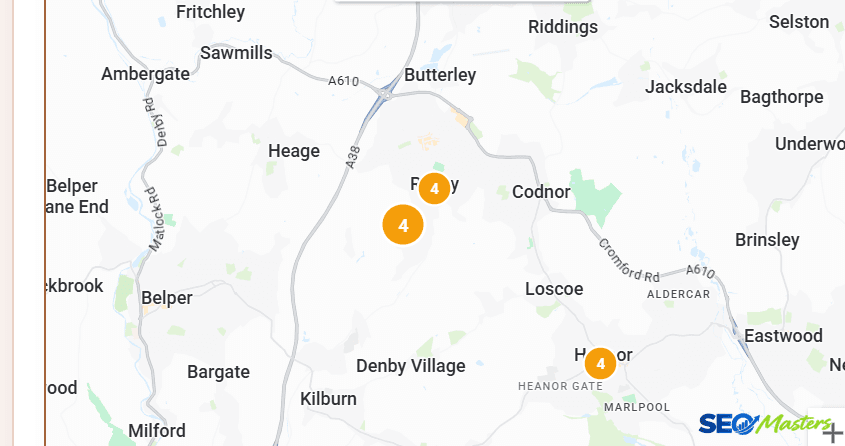
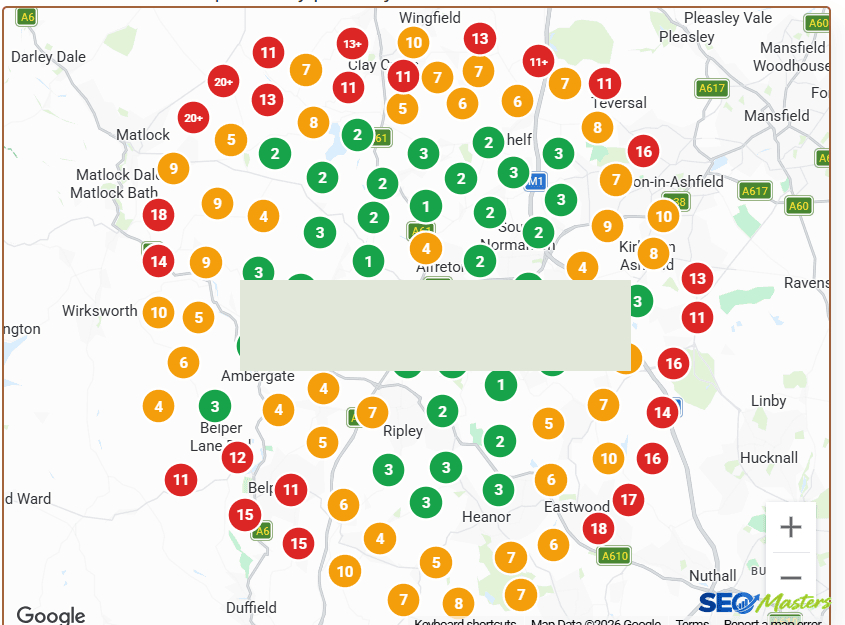
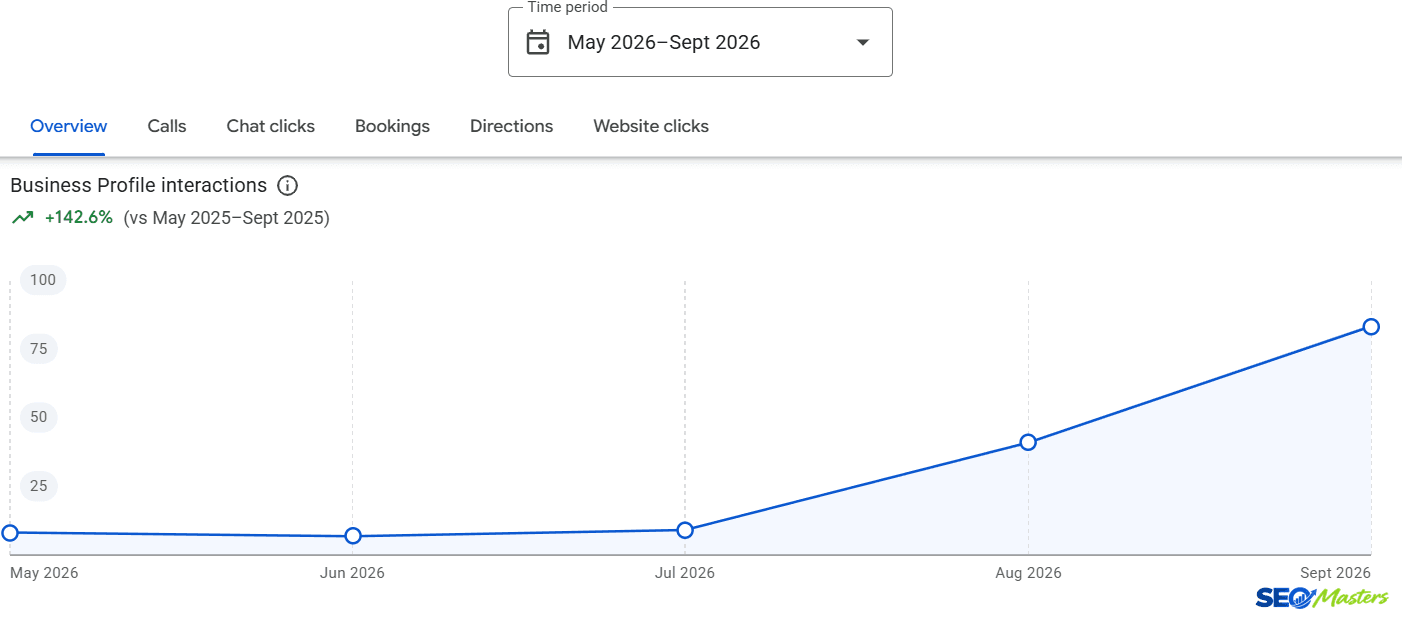
By September the numbers kept climbing. 42 reviews, 4.9 stars, 50% conversion rate, profile views up from 115 per month to 165, and interactions more than doubled from 41 to 83. The profile's visibility wasn't just strong in the immediate area anymore either, it had spread outward into surrounding towns across the wider county where it simply wasn't appearing before.
None of that involved paid advertising. If you're wondering where your own profile stands right now, our free SEO audit will tell you. It was profile optimisation, consistent posting, active review generation, and making sure the business information was accurate and complete everywhere Google looks. The same work covered in every section of this guide.
This is not a one-time job
And honestly this is the single biggest mistake I see, treating a Google Business Profile like something you set up once and then forget about. Google rewards ongoing activity, your competitors across your area are updating their profiles, collecting new reviews, and publishing content. If you stop, your profile doesn't just stay where it is, it slides, because the businesses around you keep moving and Google notices who's active and who isn't.
If you want to handle it yourself, everything in this guide gives you a solid foundation to work from. Go through each section, keep posting weekly, actively ask for reviews after every job, and keep your information up to date.
If you'd rather have someone manage it for you so you can focus on the actual work, that's what we do. Our Google Business Profile optimisation service covers the full setup and ongoing management, weekly posting, review strategy, and monthly reporting so you can see exactly what's being done and what it's producing.
Give us a call on 07355 390158 or get in touch through the website.